On May 22, BBC News reported that detectives in the Police Service of Northern Ireland had decided to pursue new and very broad subpoenas of the Belfast Project archives at Boston College. The BBC reported that news in the present tense, writing that the PSNI "is seeking" all of that archival material.
Today is June 23, and more than a month has passed. Neither the Department of Justice nor Boston College will answer questions from me, anymore, and the PSNI never did in the first place. It's possible that the PSNI is actively pursuing subpoenas, and it's possible that the DOJ is actively preparing those subpoenas. But I searched Pacer, today -- that's the case management system for the federal courts, where case documentation can be accessed and downloaded -- and I can find no sign that new subpoenas have been prepared or served.
Time will tell, but I wondered last month if the PSNI was wagging its dick at critics, in a fit of pique, with a piece of public theater that was designed to produce fear and worry rather than real investigative gains. How often do you see police departments announcing in the newspaper who they're going to raid next week?
In any event, the other shoe does not appear to have dropped, or at least not yet. Let us hope that some politicians and criminal justice bureaucrats have come to their senses.
Monday, June 23, 2014

Wednesday, June 11, 2014
Thing Discovered to Be What It Is
The
legal justice system in Northern Ireland is now discovering something
that they might always have known, if they had ever bothered to ask.
Lawyers
for Ivor Bell, who stands accused of long-ago IRA membership and
complicity in the events leading to the 1972 murder of Belfast widow
Jean McConville, have argued before a judge that the oral history
interviews being used against their client are subjective and
unreliable. They are. Indeed, they must necessarily be all of the things
Bell's lawyers say they are. Oral history interviews are valuable to
historians precisely because they are entirely subjective, the
personally framed stories that people tell about themselves.
Subjectivity and unreliable narration aren't a failure of the form;
they're an inevitable feature.
In
Los Angeles, locked in the archives at the University of California,
researchers can find the massive transcript of a long series of
interviews conducted with Jack Tenney, a California state legislator
during the communist-hunting years of the McCarthy era in the United
States. For years, Tenney chaired a committee that found communists
under every rock in Hollywood, and nearly every rock everywhere else.
"You can no more coexist with communism," Tenney said, "than you can
coexist with a nest of rattlesnakes."
There
was just one problem for California's leading slayer of far-left
monsters: He had been a well-known and longtime activist on the
political left. He spent the rest of his life trying to forget that
inconvenient past.
The
oral history interviews archived at UCLA endlessly reveal the depth of
Tenney's later self-deception, as the interviewer leads him
through a series of events and asks for his explanation. His membership
in the leftist National Lawyers Guild? Well, see, he was
sitting in his office when this young man came by and asked for two
dollars for some new organization, and Tenney was distracted, so he
fumbled for his wallet and paid the initiation fee, not knowing what he
was joining. He was later spotted at an NLG convention, wearing a
delegate's ribbon on his lapel, because he had checked into the hotel on
business without knowing the Guild was meeting there. Then he bumped
into some very, very distant acquaintances, who insisted on giving him a
ribbon as a friendly gesture, and he didn't want to offend them, so....
Tenney's
interviews go on like this for hundreds of pages, revealing a man at
war with his own life and trying to talk his way out of his past. The
interviews are, in other words, oral history: True in parts, false in
parts, often deeply revealing in both. The way a person lies about his
own life tells you as much about who he is as the parts that are
factually accurate.
The
Belfast Project, the oral history interviews of Northern Ireland
paramilitary fighters conducted under the aegis of Boston College, could
have been a project of
enormous value for historians. It would not have been valuable because
every word in every interview was true, and no historian would have
approached the interviews on those terms. The richness of the project
would have been found in its collisions between verifiable fact and
proven deception, in the way people told their own stories about the
politics of a violent past. The collection would have been an
extraordinary resource, but will now be taken apart and destroyed, piece
by piece.
That
needless act of destruction is taking place because of the breathtaking
naivete and laziness of the PSNI's hapless and
self-interested detectives, who believed they could make up for a
forty-year investigative failure by going to the Burns Library and
checking out a set of interviews that someone else bothered to conduct.
Police in Northern Ireland apparently believed they could seize a set of
academic interviews, type a few pieces into a report for prosecutors,
and deliver some justice on the cheap.
Monday, June 2, 2014
Yeah, It's Casual, We Don't Need to Protect All That, Like, Murder Investigation Stuff
At the bottom of this post, consolidated into one PDF file, are legal briefs filed today with the U.S. District Court in Boston regarding the request from NBC News to make public the Belfast Project interviews turned over by the Department of Justice to the Police Service of Northern Ireland. The government's brief is just plain odd, and seems to undercut the narrative about the PSNI pursuing a serious murder investigation rather than a political effort against the head of Sinn Fein.
But first, BC. The Boston College brief starts with a critical procedural point that the government somehow doesn't bother to make: "On May 20, 2014, a letter dated May 6, 2014, from NBC News to the Court was entered on the docket in this matter. That letter is not a motion, was not signed by a lawyer admitted to practice before this Court, and the Trustees of Boston College (Boston College) were not served with the letter but only became aware of it when counsel received notice that it had been entered on the docket."
And, I mean, yes: NBC News wants to unseal federal court records, so it dropped the judge a line. They don't have lawyers at NBC?
BC's outside lawyer, Jeffrey Swope, goes on to say exactly what you would hope and expect a university to say about confidential archival material, objecting to the release of Belfast Project interviews and interviewee identities.
The U.S. Attorney's Office in Boston, on the other hand, doesn't object to the unsealing of some of the Belfast Project interviews handed over to the PSNI, all of which are supposedly evidence in an ongoing murder investigation:
"The government has no objection to the unsealing of D.10 (7/5/11)1, D.28 (10/3/11), and D.36 (12/27/11). In addition, the government does not object to the unsealing of the sealed sidebar transcript from the hearing on February 1, 2012, except that the names of those persons identified during that sidebar conference should remain under seal. [Sealed Tr. 2/1/12 at pg. 15]. The government opposes the unsealing of D.15 (8/25/11), as it contains interview materials and other documents which were produced by Boston College in response to the MLAT subpoenas but are not otherwise publicly available."
So these are materials subpoenaed as evidence of a deadly serious murder investigation, and the investigation is ongoing, but go ahead and put a bunch of the material (that apparently damns Gerry Adams, cough cough) out on the street?
The government does oppose the unsealing of "certain pleadings filed by the United States which outline the nature and scope of the investigation which gave rise to the MLAT subpoenas," but they object to revealing the nature and scope of the investigation directly over a sentence that says the investigation "involves credible allegations of murder and kidnapping." Don't tell anyone what I'm doing, but I'm investigating a murder. That's a secret, though, so I'm not going to mention it.
The second set of subpoenas delivered back in 2011 were for every interview that mentioned the murder of Jean McConville, and then the PSNI arrested Gerry Adams and Ivor Bell over the murder of Jean McConville and interrogated them -- as Adams said when he was released -- using the Belfast Project interviews. The nature and scope of the investigation would not seem to be terribly secret, at this point, though it would be awfully interesting to see precisely how the British government framed the PSNI's request.
A hearing is scheduled for the courtroom of Judge William Young tomorrow. Here are the BC and DOJ briefs:
Friday, May 30, 2014
The PSNI Arrives on Tuesday for a Monday Lunch
They're too late.
The Police Service of Northern Ireland recently announced that they intended to make a broader MLAT request for every interview from the Boston College oral history collection they first began to mine in 2011. But Boston College also announced that it intended to return interviews to the former members of Northern Ireland paramilitary organizations interviewed for the university's Belfast Project. For a while, it appeared that the PSNI's announcement trumped BC's announcement: The news that more subpoenas were on the way would prevent the return of interviews.
For at least one Belfast Project interviewee, however, that's not what happened. Whether or not the PSNI gets the U.S. Department of Justice to subpoena the Boston College archives again, some of the interviews are out of their hands forever. They have already gone home.
Take a look at this remarkable set of documents that was posted on Pacer, the federal court system's document website, on Thursday:
Of particular interest are pages 3 and 4 of the PDF file, a May 1, 2014 letter from Jeffrey Swope, Boston College's outside lawyer for matters involving the Belfast Project, to Kevin Winters, the Belfast-based solicitor who represents former IRA member and Belfast Project interviewee Richard O'Rawe. Swope details a long list of documents and audiotapes that he is returning to O'Rawe through the offices of KRW Law, Winters' Belfast law firm. They are all of O'Rawe's interviews -- tapes and transcripts -- except the ones that the PSNI already received on account of the 2011 subpoenas. Also returned: O'Rawe's complete correspondence with the Belfast Project. There's nothing left but the material that police already have.
I don't know if material from other interviewees has already been sent back to them. Boston College and Jeffrey Swope have long since stopped responding to questions from me, and other people who would know about the return of interviews are either not responding to messages or not saying. (And I wouldn't respond to the questions I'm asking them, either, if our positions were reversed.) But if Boston College began returning interviews, there's no reason for them to have returned interviews to Richard O'Rawe but not to other interviewees, some of whom have been asking for the return of their interview material since shortly after the 2011 subpoenas arrived.
Bottom line: At least one interviewee has beat the PSNI to the archive, and maybe more. (Interviews that are unlikely to have been returned, and that are unlikely to ever be returned, are those for which Boston College has lost identifying material. So the PSNI may still be able to get its hands on interviews with unidentifiable research subjects, the legal value of which will be limited.)
Meanwhile, the political floor is beginning to give way beneath the PSNI's effort to treat the Troubles as ordinary crime.
The likelihood of a successful PSNI / DOJ return to the Belfast Project archives is rapidly fading.
Confirmed, and Still Ignored
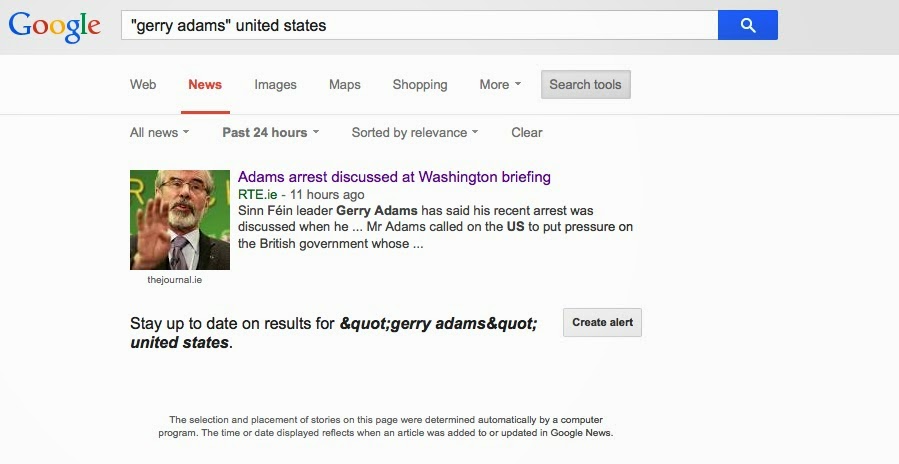
A news story on the website of RTE, Ireland's national broadcaster, confirms that Gerry Adams discussed his arrest with American officials during his visit to Washington. While the PSNI pursues new subpoenas, the RTE headline tells the whole story: "Adams arrest discussed at Washington briefing."
An email to Adams' office this morning produced a list of officials who met with Adams: In addition to a sizable group of Congressmen -- gendered term intended, because he somehow only met with men -- Adams met with some moderately well-placed officials at the State Department. The White House took relatively little notice of the meeting, sticking Adams with an official from the Office of the Vice-President. Imagine flying four thousand miles and then finding yourself in a meeting with the vice-president's staff.
In any event, yes: Gerry Adams was in a foot race with the PSNI, talking to U.S. government officials about his arrest and the foolishness of the police investigation at exactly the moment the police are trying to get new subpoenas of the Boston College archival material that they hope to use against him.
Besides RTE, which news organizations noticed the presence in the capital of a foreign official engaged in a lobbying effort against a criminal investigation that the United States is helping with? Take a look:
Thursday, May 29, 2014
Blackout
Gerry Adams is in Washington, D.C. today, "briefing senior political figures and the Obama administration on the current difficulties within the peace process." He is, in other words, lobbying one of the governments that's supposedly trying to put him in prison. Taking the mutual legal assistance treaty process and the PSNI investigation at face value, Adams is trying to talk a murder investigation off the rails -- to use politics against the police. Of course, taking that investigation at face value is...problematic, and the more likely reality is that an Irish politician is employing diplomacy this morning against a nasty piece of British politics.
Still, the drama in the moment is extraordinary: The same month he walked away from four days of police interrogation over a murder, a prominent politician is in the country where the supposed evidence against him was found, publicly announcing his intent to meet with officials in the government that helped to get him arrested. It's as if a murder suspect in New York City walked out of the interrogation room, smiled, buttoned up the cuffs of his shirt, and sauntered over to City Hall to have coffee with the mayor, patting a detective on the head as he left the precinct.
But then here's the fucking incredible part: The American news media isn't covering the visit at all. As I write this on Thursday morning, Adams has been in the country for about 24 hours, and no American news source that I can find has even mentioned his presence. He got to D.C. last night: nothing. Silence. Try your own search terms, but here are the results of a Google News search for "Gerry Adams Washington DC," narrowed to the last 24 hours:

How is it that this aggressive piece of high stakes diplomacy is drawing no attention at all?
briefing senior political
figures and the Obama administration on the current difficulties within the
peace process. - See more at: http://leargas.blogspot.com/2014/05/we-will-use-our-mandate-wisely.html#sthash.Owrexvzk.dpuf
briefing senior political
figures and the Obama administration on the current difficulties within the
peace process. - See more at: http://leargas.blogspot.com/2014/05/we-will-use-our-mandate-wisely.html#sthash.Owrexvzk.dpuf
briefing senior political
figures and the Obama administration on the current difficulties within the
peace process. - See more at: http://leargas.blogspot.com/2014/05/we-will-use-our-mandate-wisely.html#sthash.Owrexvzk.dpuf
Wednesday, May 28, 2014
Maybe Grab a Beer with Carmen Ortiz
Gerry Adams is in the United States for the next two days, meeting with federal government officials. I can't imagine what they might be discussing. Reporting on the visit is curiously thin in American news media, though that might change over the next 24 hours.
Subscribe to:
Posts (Atom)